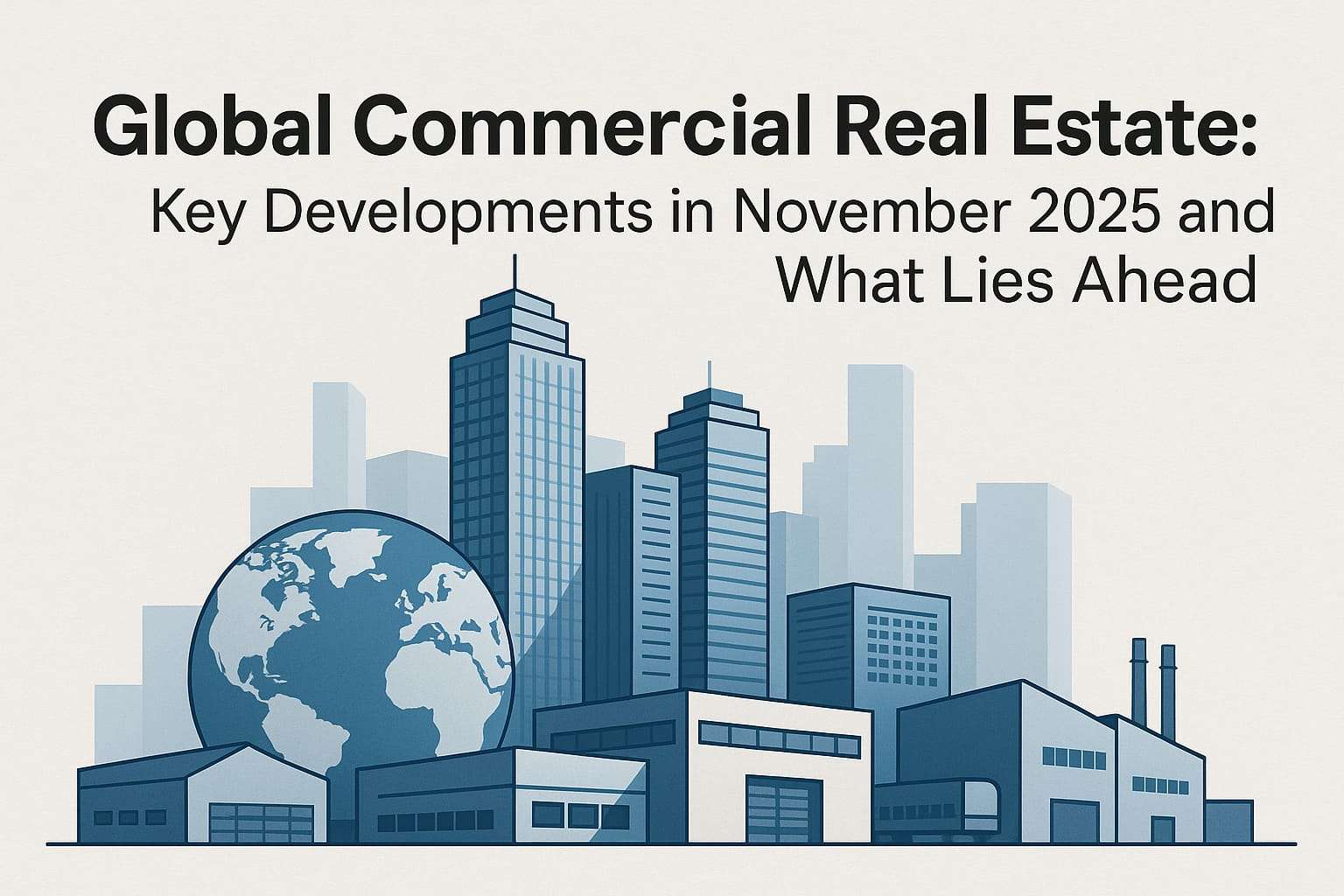
November 2025 marked a pivotal month for the global commercial real-estate sector, reflecting shifting economic trends, evolving workplace habits, strong demand in certain asset classes, and new regulatory pressures. Across major markets, investors and developers faced a combination of cautious optimism and strategic repositioning as global monetary policy began to stabilize and long-term structural changes continued to reshape commercial property demand.
Office Market: Signs of Stabilization but Structural Challenges Remain
After nearly five years of volatility, the global office sector showed early signs of leveling off.
Vacancy rates in major financial hubs—New York, London, Singapore, and Frankfurt—stopped rising for the first time since 2020. Some submarkets even recorded mild absorption as companies adopted hybrid models that required smaller but higher-quality office spaces.
Key trends:
Demand continued to shift toward Class A energy-efficient buildings, especially those offering wellness certifications and flexible layouts.
Older Class B and C buildings faced record-high vacancies, prompting accelerated conversions into residential, mixed-use, or tech-lab spaces.
Several governments, including the US and UK, advanced incentive programs to support office-to-residential conversions, signaling a policy trend likely to expand in 2026.
Future impact:
The office sector is expected to become increasingly polarized, with premium buildings gaining value while outdated assets decline unless repositioned. Urban centers may see a surge in adaptive-reuse projects over the next 3–5 years.
Retail Real Estate: A Global Comeback Led by Experience-Driven Shopping
Retail assets outperformed expectations in November 2025 as global consumer spending remained resilient. Shopping centers in Europe, the Middle East, and Southeast Asia reported stronger foot traffic, fueled by:
Growth in experience-oriented retail such as entertainment zones, specialty food halls, and immersive brand pop-ups.
Strong holiday season projections beginning earlier than usual.
Expansion of luxury brands into secondary cities, particularly in Asia.
E-commerce growth remained strong, but companies increasingly adopted omnichannel strategies, boosting demand for small storefronts combined with advanced logistics back-end facilities.
Future impact:
Retail is entering a phase of reinvention. Properties that integrate entertainment, culture, and logistics will continue to gain relevance, while traditional malls without experiential value may struggle.
Industrial & Logistics: Record Demand and Shifting Supply Chains
The industrial sector remained the most resilient segment of commercial real estate in November 2025. Global demand for warehouses, data centers, and “last-mile” distribution hubs surged due to:
Continued growth in e-commerce and same-day delivery expectations.
Ongoing restructuring of global supply chains, with companies diversifying production into Southeast Asia, India, Mexico, and Eastern Europe.
Rising demand for AI-ready data centers, driven by rapid expansion of cloud computing and machine-learning infrastructure.
Rent prices for industrial assets reached new highs in markets such as Los Angeles, Dallas, Rotterdam, Dubai, and Tokyo.
Future impact:
The industrial sector is projected to remain the strongest performer through 2026, with data centers and logistics hubs viewed as the safest long-term investments.
Hospitality & Tourism Assets: A Global Rebound Gains Momentum
Hotel performance strengthened across North America, Europe, and the Gulf region as international travel continued accelerating throughout 2025.
Notable developments:
Business-travel volumes returned to roughly 85% of pre-pandemic levels, boosting occupancy in major convention cities.
Luxury resorts in the Middle East and Mediterranean regions reported exceptionally high ADR (Average Daily Rate).
Investors increased acquisitions of boutique hotels and extended-stay properties targeting remote workers and digital nomads.
Future impact:
The hospitality sector is expected to expand moderately in 2026, though performance will vary by region. High-end leisure destinations continue to outperform business hotels.
Capital Markets: Liquidity Improving but Still Selective
November 2025 saw slightly improved liquidity in global commercial real-estate markets due to:
Stabilization of interest rates in the US, EU, and several Asia-Pacific countries.
Increased appetite from institutional investors for long-duration assets, especially logistics and multifamily-conversion projects.
A rise in cross-border acquisitions, particularly from Middle Eastern sovereign funds and Asian private equity groups.
However, financing remained challenging for office, retail, and under-performing assets, with lenders focusing heavily on risk mitigation.
Future impact:
If interest rates continue stabilizing or decline in 2026, transaction volume is expected to rise, though lending will remain conservative for lower-performing asset classes.
Regulatory & Sustainability Pressures: Green Compliance Becomes a Global Standard
Governments across Europe, North America, and Asia accelerated new building-performance regulations, including:
Mandatory energy-efficiency upgrades.
Carbon-reporting requirements for large commercial properties.
Incentives for retrofitting older buildings to meet 2030 emissions targets.
These policies are reshaping investment strategies as environmentally non-compliant assets risk losing value.
Future impact:
Sustainability compliance will be one of the strongest drivers influencing valuations and redevelopment decisions in the coming decade.
---
Conclusion: A Market in Transition with Clear Winners Emerging
The commercial real-estate market in November 2025 demonstrated resilience mixed with structural shifts.
While office and traditional retail continue to face long-term challenges, industrial, data centers, hotels, and high-quality office properties remain strong performers.
Looking ahead to 2026–2027, the markets poised for the most growth will be those aligned with:
Digital infrastructure
Supply-chain transformation
Sustainability requirements
Hybrid work requirements
Experience-driven consumer behavior
Investors and developers who adapt early to these trends are likely to lead the next wave of commercial real-estate innovation.