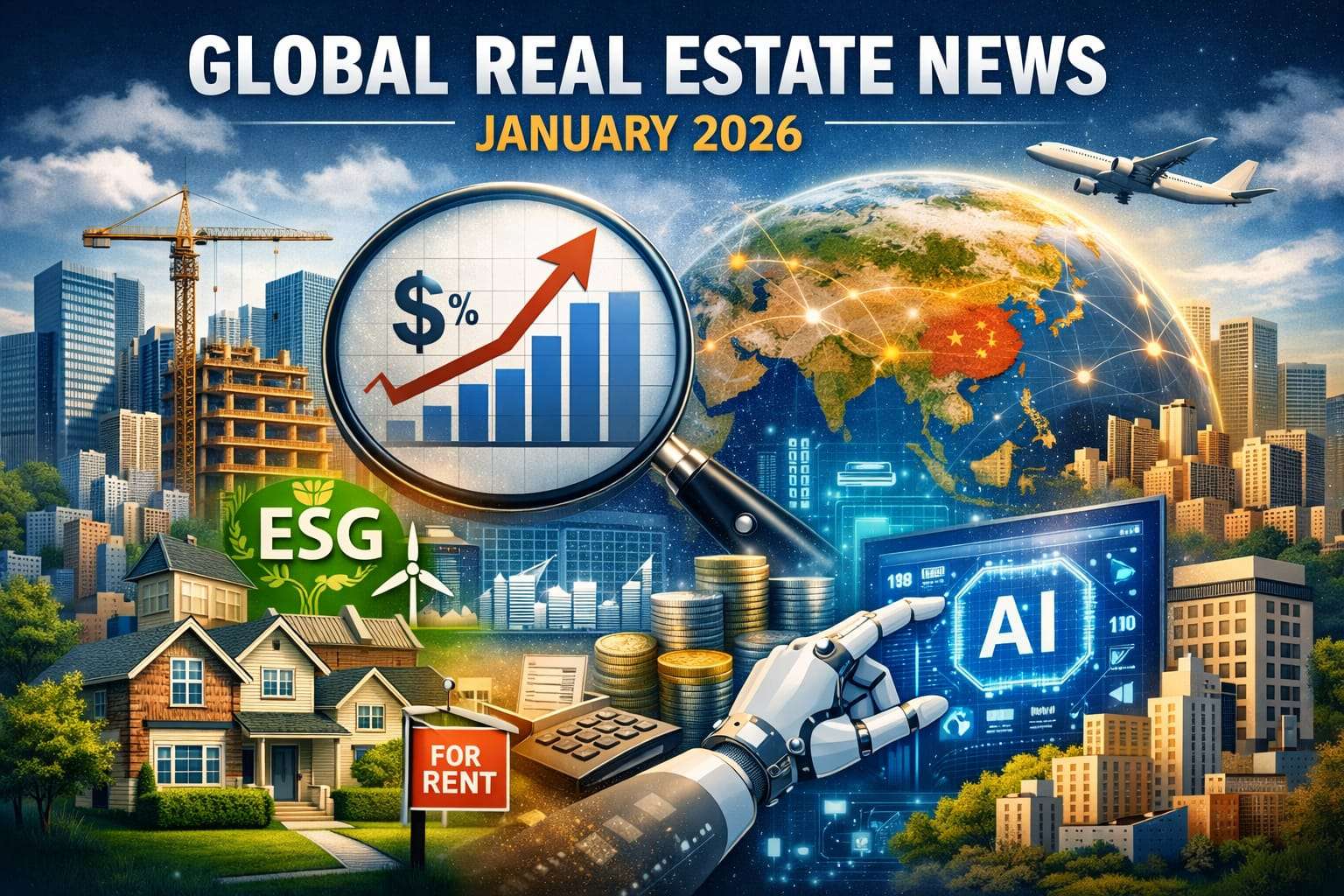
January 2026 highlighted several structural shifts shaping global real estate. Rather than short-term volatility, the month reinforced longer-term trends in financing, technology, housing policy, and asset re-pricing across regions.
1. Interest Rates: From Shock to Adjustment
Central banks, led by the Federal Reserve and the European Central Bank, maintained restrictive but more predictable monetary policies.
Impact on the future
Real estate markets are moving from rate shock to rate normalization.
Investors increasingly price assets using higher “new-normal” discount rates.
Long-term fixed-rate financing regains importance, favoring institutional players with strong balance sheets.
2. Housing Shortages Drive Policy Intervention
Acute housing supply gaps persisted in North America, Europe, and parts of Asia. Governments accelerated zoning reforms, modular construction approvals, and public-private partnerships.
Impact on the future
Faster permitting and densification policies may permanently change urban planning.
Build-to-rent (BTR) and multi-family housing gain priority over speculative for-sale projects.
Cities that streamline approvals are likely to attract disproportionate capital inflows.
3. Commercial Real Estate: Office Reset Continues
Office markets remained bifurcated: prime, energy-efficient buildings stabilized, while older stock faced declining valuations.
Impact on the future
Conversion of obsolete offices into residential or mixed-use assets becomes mainstream.
“Flight to quality” accelerates, widening value gaps within the same city.
Hybrid work solidifies as a permanent planning assumption, not a temporary disruption.
4. Artificial Intelligence Becomes Infrastructure
AI adoption moved beyond experimentation into core real-estate operations: pricing, tenant screening, asset management, and predictive maintenance.
Impact on the future
Data-driven valuation reduces information asymmetry, compressing excess returns.
Smaller investors rely on AI platforms, increasing market transparency.
PropTech consolidation is likely, as AI systems require scale and high-quality data.
5. China and Emerging Markets: Selective Recovery
In China, policymakers continued targeted support for developers and homebuyers, while avoiding broad stimulus. Emerging markets showed mixed performance, driven by local inflation and currency dynamics.
Impact on the future
Global capital becomes more selective, favoring politically and fiscally stable markets.
Regional diversification replaces blanket “emerging market” strategies.
Local demographics and urbanization trends outweigh short-term macro cycles.
6. Sustainability and Regulation Tighten
Energy-efficiency standards and ESG disclosure rules expanded across Europe and parts of Asia.
Impact on the future
“Brown discounts” (price penalties for inefficient buildings) deepen.
Retrofitting becomes a core investment thesis, not a compliance afterthought.
Green financing increasingly determines asset liquidity.
Big Picture: What January 2026 Signals
January did not mark a dramatic turning point—but it confirmed a structural transition:
From cheap capital → disciplined financing
From speculative growth → income stability
From intuition → data and AI-driven decisions
From uniform markets → highly segmented winners and losers
Looking ahead, the future of global real estate will favor adaptability, technological integration, and alignment with demographic and regulatory realities. Markets and investors that internalize these shifts early are likely to outperform in the coming decade.