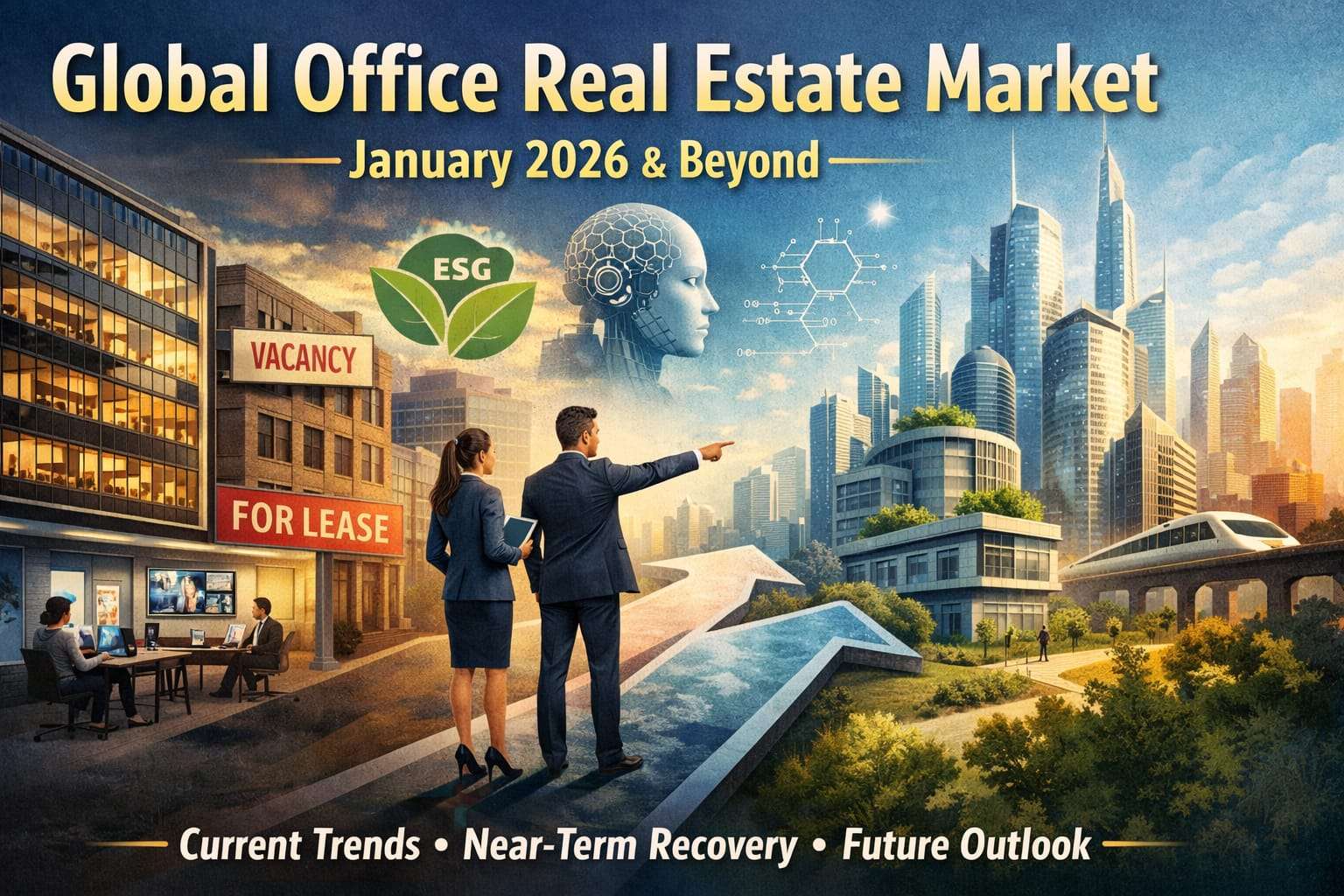
As 2026 begins, the global office real estate sector finds itself in a dynamic, evolving phase — shaped by post-pandemic work trends, shifting occupier preferences, macroeconomic forces, and emerging technologies. After several years of uncertainty, markets are beginning to reset and reprice, creating both opportunities and challenges for investors, occupiers, and cities worldwide.
📌 Current State of the Office Market
1. Continued Demand for High-Quality Space Prime office properties — especially in major financial and commercial hubs — are experiencing strong demand and rising rents. Landlords of trophy space and high-amenity buildings are seeing elevated leasing activity as companies seek to attract talent back into the workplace with upscale amenities. In cities like New York, premium offices have recorded record leasing activity, supported by strong demand from finance, tech, and professional services sectors. �
Financial Times
At the same time, recent data show that prime office vacancies are falling in key U.S. urban markets as supply remains constrained relative to demand. �
Allwork.Space
2. Vacancies Still Elevated in Secondary Markets Despite pockets of strength, overall office vacancy remains above pre-pandemic levels in many regions. Older, less flexible buildings continue to face challenges due to persistent hybrid and flexible work arrangements and slower office attendance. Many employers remain selective about space quality and location, which has left a surplus of lower-tier office inventory. �
PwC
3. Hybrid and Flexible Work Normalize Hybrid work isn’t disappearing — rather, it has become the baseline expectation for many companies. This means space utilization patterns are permanently different from the pre-COVID era, with occupiers focusing on collaborative areas and flexible workspace formats instead of traditional desk layouts. �
CommercialSearch
4. Office Construction Near Historical Lows New office construction is now at historically low levels in several major markets. This slowdown — partly driven by higher construction and financing costs — could help rebalance the market as future supply growth is limited. �
מרקוס מיליכאפ
📈 Near-Term Outlook (2026–2028)
1. Gradual Improvement and Stabilization Industry forecasts suggest the office sector has bottomed and is beginning to stabilize. Limited new supply and modest net absorption gains could help reduce vacancy rates further through 2026 and 2027, especially for high-quality buildings. �
Carnm
2. Selective Rent Growth Prime office rents are expected to rise in most major global markets, driven by tight supply and demand for best-in-class space. Secondary assets, however, will likely lag unless repositioned or retrofitted to meet modern needs. �
Savills Impacts
3. Repositioning and Repurposing Developers and investors are increasingly exploring adaptive reuse — converting traditional office buildings into mixed-use developments, luxury residential units, or flexible work environments — to unlock value and respond to evolving demand. �
Carnm
4. Flex and Satellite Workspaces Grow As companies balance hybrid policies, flexible and satellite workspaces are gaining traction. Operators of flexible workspace — especially in markets like India — are expanding rapidly, highlighting a shift in how office demand is structured. �
The Economic Times
5. ESG and Tech Integration Sustainability features and technology — from smart building infrastructure to energy efficiency — are increasingly key decision drivers for occupiers and investors. Offices that integrate these elements are outperforming those that don’t.
📌 Long-Term Outlook (Beyond 2030)
1. Reinvention of Office Purpose The long-term future of office real estate is not one of obsolescence, but transformation. Offices are evolving into “experience hubs” — places where human collaboration, creativity, and culture are prioritized over mere task execution.
This means greater emphasis on:
Amenity-rich environments
Health and wellness design
Flexible layouts and shared collaboration zones
Technology-enabled smart spaces
2. Urban Resilience & City Centers Many downtowns — particularly in major global cities — are expected to regain strength as employers and workers seek proximity to talent, services, and networks. Cities that invest in transit, mixed-use development, and quality public space may see stronger office demand. �
Cushman & Wakefield
3. Hybrid Work Is Here to Stay Remote and hybrid work models won’t vanish. Instead, they will continue to balance with in-office collaboration needs, creating a dual market for traditional headquarters and distributed work locations.
4. Technology’s Continued Impact Artificial intelligence (AI) and data analytics are increasingly used to track utilization, enhance efficiency, and optimize real estate portfolios — giving landlords and occupiers powerful tools to drive better decision-making.
🧭 Key Forces Shaping the Future
Force
Impact
Economic Conditions & Interest Rates
Influence investment flows, construction activity, and valuations. �
Commercial Property Advisors
Workplace Strategy Evolution
Defines space requirements and utilization. �
Weigand Real Estate
Sustainability & ESG
Drives tenant preference and investment attractiveness.
Technology & AI
Enhances workplace experience and operational efficiency.
Urban Policy & Infrastructure
Shapes long-term demand for centralized offices.
📌 Conclusion
By January 2026, the global office market is moving beyond crisis mode and into adaptation and selective growth. The next few years are likely to see stabilization of vacancy rates, increased demand for quality space, and more innovation in how offices are used. In the long run, offices will remain relevant — but increasingly as centers of collaboration, culture, and innovation, not merely as rows of desks.