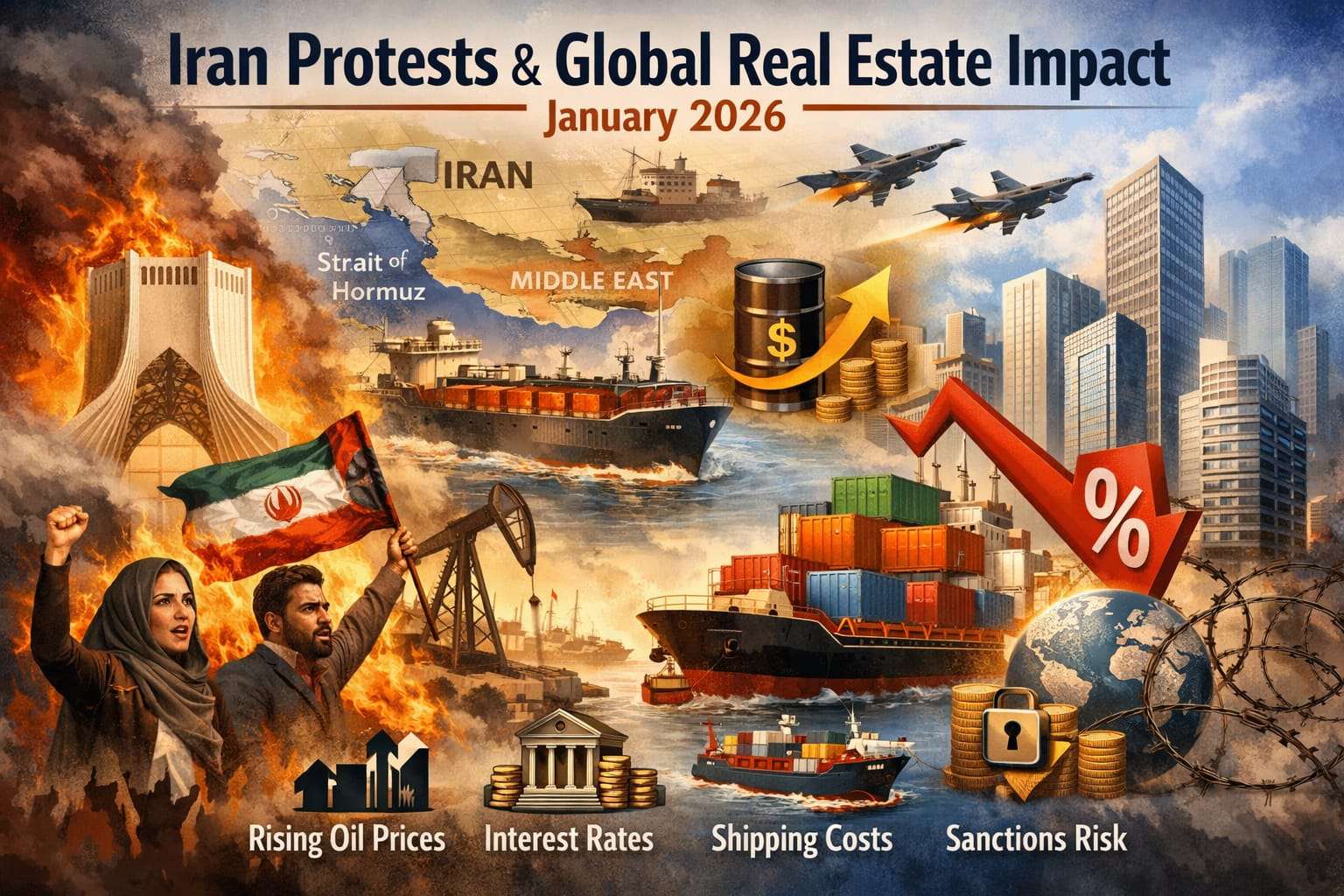
In early January 2026, Iran entered a fresh period of unrest as protests that reportedly began in late December escalated into wider anti-government demonstrations—alongside a tightening security response and reported communication blackouts. �
The Guardian +1
While real estate is local by nature, global property cycles are heavily influenced by macro forces that can change fast: inflation expectations, interest-rate paths, credit spreads, and cross-border capital flows. Iran’s internal instability matters because it can reprice energy risk and regional security risk, which then cascades into financing costs and investor behavior worldwide.
1) Energy prices → inflation → interest rates → cap rates
Iran sits in the middle of a region central to global oil flows and risk sentiment. When markets fear supply disruptions (or fear that disruptions could spread), oil prices can react immediately—raising inflation expectations and pressuring interest-rate expectations, even if no disruption has yet occurred.
A clear signal appeared as oil prices rose amid market concerns tied in part to intensifying protests in Iran, according to Reuters reporting on Jan 9, 2026. �
Reuters
Why this matters for property:
Higher oil can feed higher transport and materials costs (construction) and higher CPI (macro).
Higher CPI risk often means “higher for longer” rates, which tends to push property yields up (cap rates) and asset values down, especially in highly leveraged sectors (multifamily development, offices with refinancing needs, value-add deals).
Countries that are net energy importers (many in Europe and Asia) can feel the financing pressure faster, which can cool transaction volumes.
2) Risk-off markets → capital rotates to “safe” property and safe currencies
When geopolitical tension rises, many institutional investors reduce exposure to perceived risk (emerging markets, frontier assets, cyclical sectors) and increase allocations to:
USD assets, high-quality sovereign debt, and
Core real estate in “safe-haven” cities with deep liquidity (e.g., top-tier markets in the U.S., Canada, parts of Western Europe, Singapore).
This typically shows up first as:
Wider credit spreads (more expensive real estate debt),
A preference for prime assets over secondary locations,
More cautious underwriting (lower rent growth assumptions, higher exit cap rates).
In practice: if Iran-driven volatility persists, it can slow global deal flow and increase the discount rate investors apply to future income—especially in sectors already sensitive to rates (office, discretionary retail).
3) Shipping and insurance risk → construction costs and delivery timelines
Even without an actual closure of chokepoints, higher war-risk premiums and elevated shipping insurance in the wider Middle East security environment can raise delivered costs for building materials and equipment.
During earlier regional tensions, Reuters reported that war-risk insurance premiums for voyages involving the Strait of Hormuz area increased materially in 2025. �
Reuters
Transmission to real estate:
Higher shipping/insurance costs can push up prices for imported materials (steel products, fixtures, MEP components), extending project budgets.
Developers may react by delaying starts, scaling back speculative projects, or demanding higher pre-leasing/pre-sales thresholds.
In markets with thin supply pipelines, construction delays can paradoxically support rents (less new supply), but also reduce transaction activity and development margins.
4) Sanctions and compliance risk → banking friction and reduced cross-border liquidity
A harsher crackdown narrative—especially with reported large-scale detentions and threats of severe charges—can trigger renewed diplomatic pressure and potentially tighter sanctions posture. �
The Guardian +1
Even without “new sanctions headlines,” compliance departments often become more conservative when a jurisdiction becomes a top risk story. That can lead to:
More friction in correspondent banking and trade finance,
Reduced appetite for regional exposure among global lenders,
Higher required returns for any projects tied to Middle East risk (even indirectly through tenants, logistics, or supply chains).
Real estate feels this through less available debt and more expensive capital.
5) Regional ripple effects: MENA pricing, tourism, and expat-driven demand
If unrest and crackdown concerns persist, the region may experience:
Short-term tourism caution in nearby destinations,
Shifts in expat plans, and
Potential capital inflows into perceived “stable” regional hubs (in some cycles, Gulf gateway cities can benefit from investors seeking safety within the region—though outcomes depend on whether broader tensions rise or remain contained).
So the effect is not uniformly negative: volatility can re-route capital rather than simply destroy it.
6) Scenario outlook for global property (2026)
Scenario A: Contained unrest, no material supply disruption
Oil risk premium rises but stabilizes.
Global real estate impact: mildly higher financing costs, slower deal volumes, prime assets favored.
Scenario B: Prolonged unrest + elevated regional security risk
Higher oil volatility + higher insurance and shipping costs.
Global real estate impact: development slows, more repricing in rate-sensitive markets, stronger safe-haven bid.
Scenario C: Escalation beyond Iran (regional flashpoints)
Risk-off becomes broad, credit tightens.
Global real estate impact: wider cap-rate expansion, distressed refinancing pockets, and more “flight-to-quality” in top-tier markets.
Bottom line
Iran’s January 2026 protest wave is less about Iran’s domestic housing market influencing the world directly—and more about how energy risk and geopolitical volatility can reprice the two things real estate depends on most: money (interest rates and credit) and confidence (risk appetite). Oil-market sensitivity to Iran-related risk has already been visible in early January pricing moves, and continued unrest—especially alongside communication blackouts and intensified repression—can keep that risk premium alive.