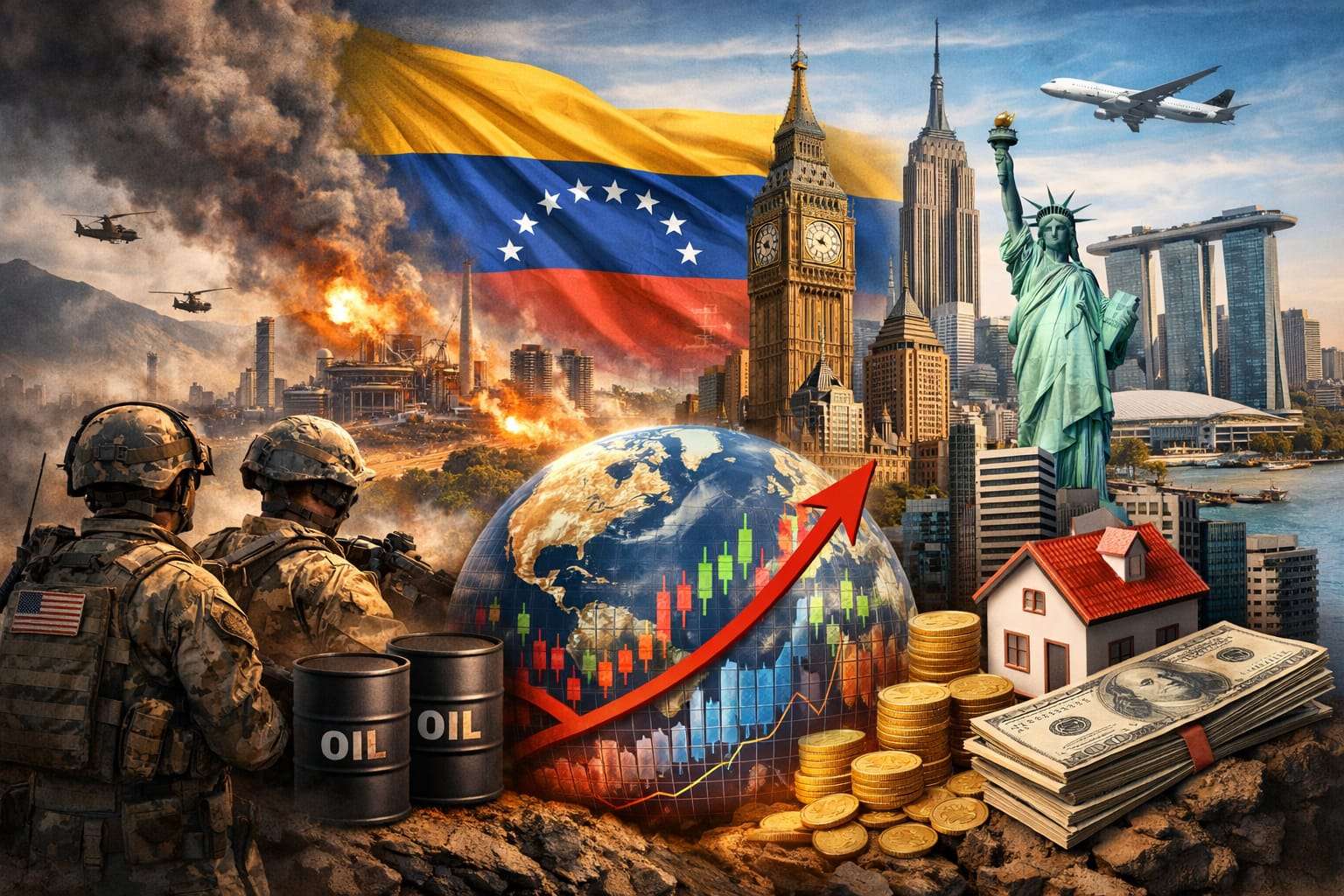
In the first week of January 2026, U.S. forces carried out a high-profile military operation in Venezuela, seizing President Nicolás Maduro and transporting him to the United States to face federal charges. The dramatic action — which included extensive strikes and control over Venezuelan oil assets — has unsettled global markets and raised geopolitical tensions. �
ויקיפדיה +1
While the immediate focus has been on geopolitics, energy markets, and international law, economists and real estate analysts are already debating how these events might influence global property markets in the months and years ahead.
1. Energy Prices and Investment Flows: A Key Market Driver
At the heart of the Venezuela crisis is oil — a resource that has been at the center of U.S.–Venezuela tensions for years. The Trump administration asserts it will export millions of barrels of Venezuelan crude to U.S. markets, injecting up to 50 million barrels into global supply chains. �
AP News
Why this matters for real estate:
Stabilizing or reducing oil prices could boost consumer confidence in energy-dependent economies, particularly in Europe and Asia, potentially increasing demand for commercial real estate in those regions. Lower energy costs reduce overhead for businesses and can encourage investment in office and industrial spaces.
Conversely, geopolitical risk premiums could keep energy prices volatile, which often leads investors toward “safe haven” assets like U.S. Treasury bonds and prime real estate in stable markets (e.g., New York, London, Tokyo), putting upward pressure on prices in those markets.
2. Capital Flight and Asset Diversification
Periods of geopolitical risk often trigger capital flight — especially from emerging markets — as investors relocate wealth into perceived safe assets.
Real estate, particularly in markets with strong rule of law and liquidity, such as:
U.S. coastal cities (New York, Miami, San Francisco)
European hubs (London, Berlin, Paris)
Asia Pacific anchors (Singapore, Sydney, Tokyo)
may see increased demand, driving prices higher as global investors seek stability.
This pattern was observed during past crises, such as the 2008 financial downturn, when capital flowed toward U.S. and European real estate. While Venezuela itself is not a major global property investor, its export disruption affects markets indirectly via investor psychology and risk appetite.
3. Risk Perception and Flight to Safety
The U.S. action in Venezuela represents a significant escalation in Western Hemisphere geopolitics, drawing global criticism and concern from many governments. �
AP News
Heightened geopolitical risk tends to:
Elevate demand for “safe” real estate: luxury residential and prime commercial properties in politically and economically stable cities.
Shift capital out of frontier or emerging markets: investors may retreat from riskier markets in Latin America, Africa, and Southeast Asia in favor of established real estate hubs.
Increase interest in alternative real estate sectors: like logistics and data centers, which benefit from digital economy resilience.
4. Oil-Driven Economies and Regional Real Estate Impact
Countries heavily tied to oil economies — including Middle Eastern states, parts of Africa, and Latin America — could experience secondary effects:
If Venezuelan oil enters global markets under U.S. control, it could change supply dynamics, pressuring oil producers that rely on higher prices to buoy their economies.
Regions that depend on oil finance for infrastructure projects may scale back, slowing commercial real estate development and affecting income for investors in projects tied to state budgets.
This could cool real estate markets in some energy-dependent cities, while boosting demand in diversified, technology-driven metros.
5. Currency Fluctuations and Capital Mobility
Political instability often leads to currency volatility. If the Venezuelan intervention affects confidence in neighboring economies, FX volatility could rise.
For real estate:
Stronger major currencies (USD, EUR, JPY) often attract foreign buyers, making property in these currencies more appealing to international investors seeking hard assets.
Weaker emerging market currencies can make local real estate less attractive to global capital, shifting investment to stable currency zones.
Looking Ahead: What Investors Should Watch
The implications of the U.S. operation in Venezuela for real estate are not direct — but they are real and interconnected through global energy markets, investor risk sentiment, and capital flows. Analysts suggest keeping an eye on the following:
Oil price trends and supply shifts
Inflation and interest rate policy responses
Investor flows into safe-haven real estate markets
Shifts in development patterns for energy-tied economies
Geopolitical risk indices and their influence on long-term property investments
In a highly interconnected global economy, geopolitical shocks rarely remain isolated. The reverberations from Venezuela could shape where, how, and in which sectors real estate capital allocates globally in 2026 and beyond.