1. Gradual Return of Global Capital to Real Estate
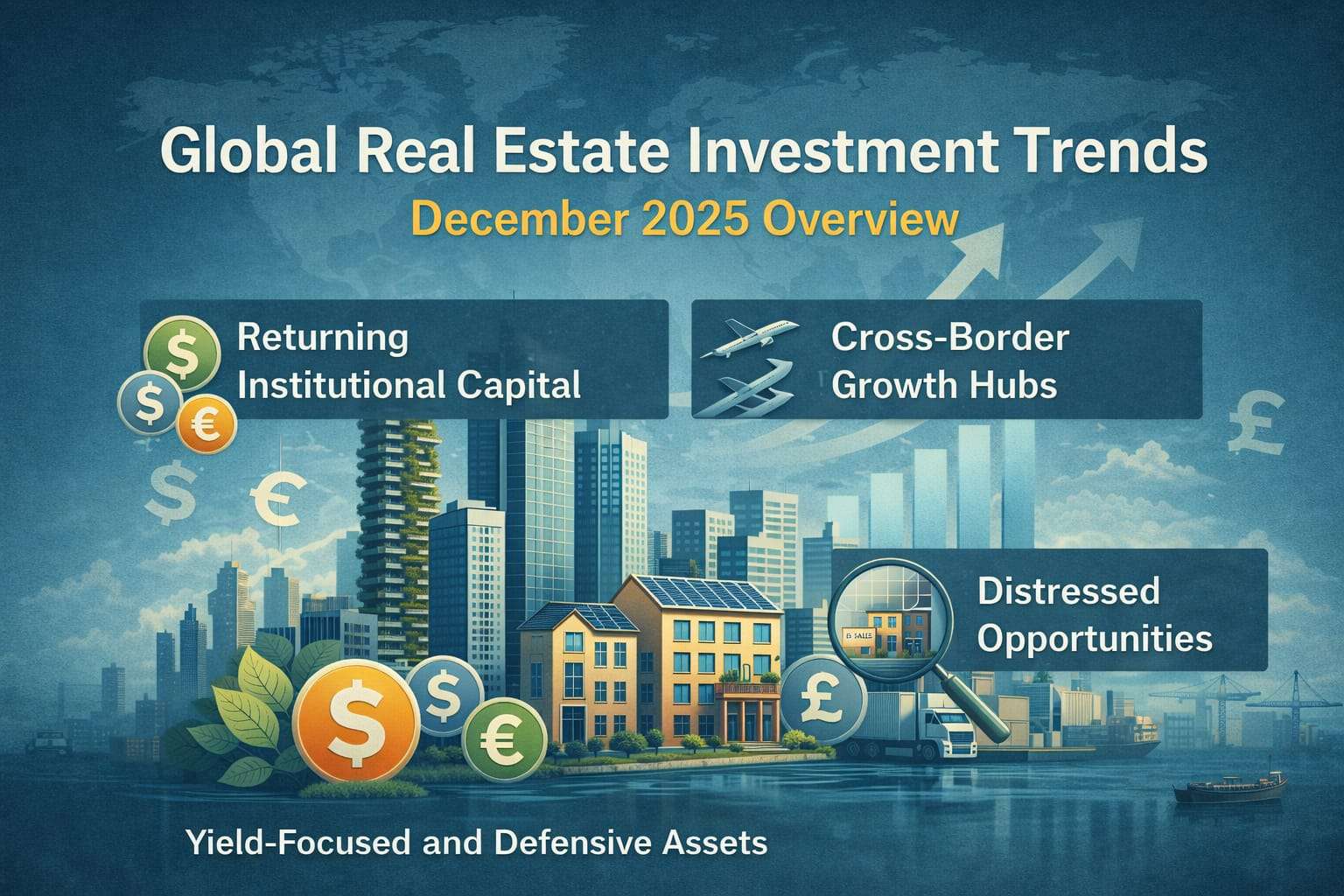
In December 2025, global real estate investment activity showed clear signs of recovery after a cautious period driven by high interest rates and economic uncertainty. Institutional investors, including pension funds, private equity firms, and sovereign wealth funds, began selectively re-entering the market, focusing on assets with stable income and long-term fundamentals.
Future impact:
This renewed capital flow suggests 2026 may mark a turning point, with increased transaction volumes and improved liquidity, especially in prime and well-located assets.
2. Strong Focus on Yield-Driven and Defensive Assets
Investors continued to prioritize income-producing sectors such as residential rental housing, logistics, healthcare real estate, and data centers. These assets were viewed as more resilient to economic volatility and inflation, offering predictable cash flows compared to traditional office properties.
Future impact:
Yield-oriented strategies are likely to dominate investment decisions, encouraging further development and consolidation in defensive and alternative real estate sectors.
3. Continued Weakness in Traditional Office Markets
Office real estate remained under pressure in many global cities, with elevated vacancy rates and declining asset values, particularly in secondary locations. However, prime offices with high sustainability standards and flexible layouts attracted selective investor interest.
Future impact:
The office sector is expected to undergo structural transformation, with capital concentrating on fewer, higher-quality assets and ongoing repricing of outdated buildings.
4. Expansion of Cross-Border Investment in Growth Hubs
December 2025 saw increased cross-border investment activity in high-growth regions, including the Middle East, parts of Asia, and selected European cities. Dubai, Singapore, and major logistics hubs benefited from strong international demand driven by population growth, business-friendly policies, and infrastructure investment.
Future impact:
Cross-border capital flows are likely to intensify, reinforcing the role of global cities and emerging hubs as focal points for international real estate investment.
5. Rise of Distressed and Value-Add Opportunities
Higher financing costs continued to pressure leveraged property owners, leading to an increase in distressed sales and refinancing challenges. Opportunistic investors actively sought discounted assets, particularly in residential development, offices, and mixed-use projects.
Future impact:
Distressed and value-add strategies are expected to remain attractive in 2026, potentially accelerating market rebalancing and ownership transitions.
6. Sustainability and Regulation Shaping Investment Decisions
Environmental regulations and energy-efficiency standards became increasingly important in December 2025. Investors showed strong preference for assets aligned with ESG requirements, while properties failing to meet sustainability standards faced higher capital expenditure needs or reduced demand.
Future impact:
Sustainability will continue to influence pricing, financing, and long-term asset viability, pushing investors toward greener and more energy-efficient properties.
Overall Outlook for the Future
December 2025 reinforced the view that global real estate is entering a selective recovery phase rather than a broad-based boom. Capital is returning, but with stricter underwriting, a strong focus on income, sustainability, and location quality.
Key Takeaways for the Future:
📈 Gradual recovery in global real estate investment volumes
🏢 Ongoing restructuring of the office sector
🏘️ Strong demand for residential and alternative assets
🌍 Growing importance of cross-border investment hubs
♻️ Sustainability becoming a decisive investment factor